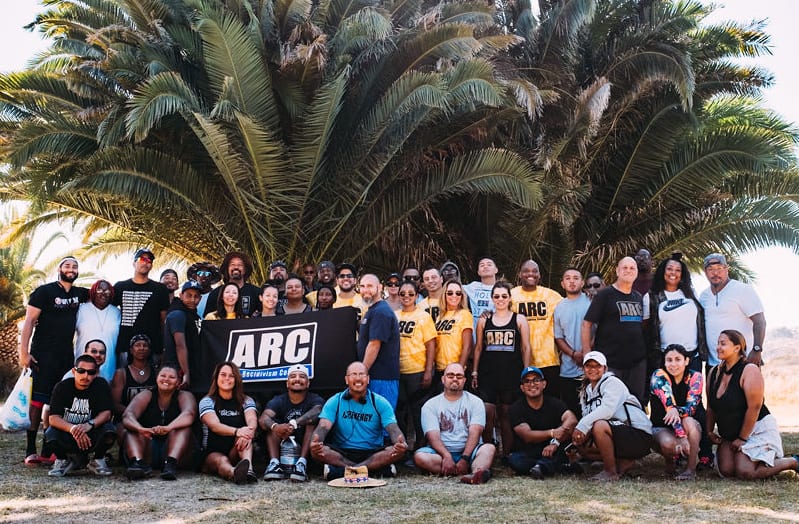
A conversation with Johnson Thieu, Product Manager at The Last Mile and ARC alumnus
Like most things in prison, our Hope and Redemption Team (HART) classes have always been analog. Lessons and assignments stored in looseleaf folders and notebooks. Graduation certificates meant for students’ C-files ended up missing or lost, leading to real issues at parole hearings.
The lack of technology has not only inhibited class progress, but kept students from accessing one of the most valuable and necessary tools in our modern world – the computer.
Thanks to a new partnership with The Last Mile (TLM), an organization that prepares incarcerated people for high-paying careers in tech and other industries, that is changing.
As of this spring, HART students at San Quentin will receive laptops loaded with a fully digital platform to track courses, curriculum, and assignments.
At the center of this partnership is Johnson Thieu, The Last Mile’s Product Manager and the man who responsible for launching the platform. He’s also an ARC alum who participated in both programs on the inside. We sat down with him to hear his story.
Tell us about where you grew up and how you ended up incarcerated.
I grew up in El Monte in the ’80s. Pretty rural, farmland, strawberry patches. My parents came over after the Vietnam War and worked constantly, which meant they weren’t around much. I was looking for a place to belong and found it in the wrong places.
At 19, I was convicted of second-degree murder. In 2002, I arrived at Pelican Bay.
How did you find your footing inside?
The first years were about survival. Pelican Bay was totally segregated. You weren’t thinking about education. You were thinking about whether you’d get to call your mom.
Eventually I transferred to Ironwood, closer to my family. My parents started visiting. We’d eat microwave food together and I’d think: this is our home-cooked meal now. I was 22. That’s when I knew I had to do something different. I enrolled in college through Palo Verde Community College and ended up earning seven degrees on the inside.
When did ARC enter the picture?
Around 2014, Scott Budnick started showing up at Ironwood. Nobody knew what was happening — everybody was just hoping for a second chance. And here’s this guy saying prison reform matters for all of us, not just people on the outside. Whenever there was a graduation, he was there.
That was eye-opening. Up until that point, I never really believed people on the outside actually cared. My partner, Mark A. Taylor, and I even developed an emotional intelligence course that became a required part of ARC’s youthful offender program. That planted a seed. I knew when I came home, I wanted to keep doing this kind of work.
And The Last Mile?
They came into Ironwood around the same time. I was a Braille transcriber, which was the most prestigious job inside, paying a dollar an hour. But when Beverly Parenti (from TLM) spoke about the need to fill a projected 20% shortage in software engineering roles by 2020, I quit my job, interviewed and got in.
The Last Mile and ARC always felt like the same mission to me. Wherever one showed up, the other wasn’t far behind.
What happened when you came home?
I came home in 2017 with no phone and no way to reach anyone. But I knew The Last Mile’s address in San Francisco so I showed up at their office. They welcomed me with open arms.
Tell us about the platform and what it means for ARC.
We take an organization’s existing curriculum and digitize it inside Canvas, a Learning Management System. Students interact with it on a laptop, submit assignments, and everything is logged. They don’t lose their progress, even when they transfer facilities.
For ARC, this means a real digital record of coursework for the first time. Remote instruction. Guest speakers via screen. And since the platform is live in 13 states, scaling Hope and Redemption nationally is genuinely just a flip of a switch.
What does this mean to you personally?
When I talk to Last Mile students about ARC, they say: “We want that here.” That’s all the proof you need.
I think about the emotional intelligence course I helped write in a prison cell in 2011. Now I’m building the platform to take it national. There are moments in life you don’t realize are turning points until you’re on the other side of them. The step I took 11 years ago led me directly here.
Stay tuned for more as we grow this partnership at San Quentin and beyond.