By Communications Associate, Vanessa Gutierrez
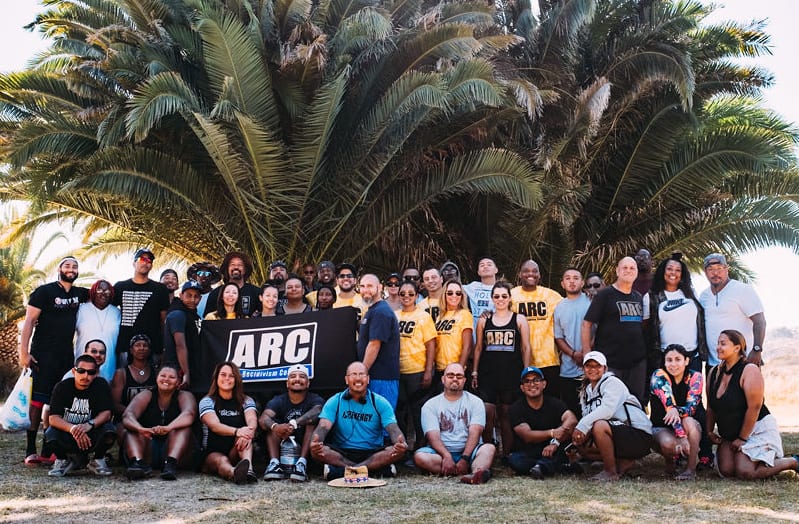
A few weeks before Mother’s Day, ARC held an event for the children of incarcerated mothers and their caregivers. As the new Communications Associate, I joined to take pictures.
As the scent of cookies filled the air, laughter rose above the music, and little footraces to see who was fastest clogged the halls, I noticed myself feeling a bit morose.
I’m capturing a snapshot of these kids’ lives. They’re happy and having fun right now, but I’m not seeing the moments when they miss their moms, when they fall and get hurt and all they want is their mom. I’m not seeing their caregivers’ struggles, some of whom are grandmothers starting parenthood all over again.
I want to believe it’s none of my business, but I’m reminded that it is. The ethos behind ARC’s ‘Till Your Mom Gets Home (TYMGH) program is that we are all responsible for each other’s children, especially those separated from their parents by our carceral system.
The reality is over 62% of incarcerated women in state prisons have a child under the age of 18. That’s a lot of children without their mothers. That is a lot of families stepping up and caring for children, who don’t have their moms.
I joined ARC’s Communications Department in January 2026. Like many of you, I discovered ARC during the LA fires in 2025. Since then, I have learned about the plethora of programs and groups ARC offers, including the Hope and Redemption Team (HART), where former lifers go back to prisons to help other lifers change their lives with the goal of release, and, more recently, TYMGH.
TYMGH is an initiative started by ARC’s very own, Norma Cumpian, a former lifer who raised her own son while incarcerated. The program exists to provide the support she didn’t have to other incarcerated mothers, their children, and their guardians as they navigate the separation.
As I looked at the demographics of the families that attended the event, I found that they reflected national statistics.
The incarceration rate for Black women (68 per 100,000) is 1.7 times the rate of imprisonment for white women (41 per 100,000) with Latina women at 1.2 times the rate of white women (51 per 100,000).
In laymen terms, minority women and families are affected by the prison system at higher rates. That’s who filled ARC’s space that day.
I took in the weight of this information as I prepared my camera for the day.
At 10AM, ARC staff and a handful of volunteers helped set up, decorate, and organize the “activity stations” for the day.
At 11AM, the children and their caregivers arrived, welcomed by a full red-carpet, posters that said, “Your mom sent us” and “Your mom loves you!,” balloons, cheering, and music. One child, about 5, who I have a feeling will be a leader later in her life, strutted down the red-carpet, immediately “understanding the assignment,” as the kids say these days.
Introductions and a group session followed. This was where things got a little emotional for me, admittedly. Every ARC event has a moment like this, I’m discovering—a moment where people share their deepest vulnerabilities with such poise, directness, and honesty—a moment where, behind the lens, I hold back tears and try not to fog up the viewfinder of the camera.
Staff and volunteers introduced themselves, sharing their stories of incarceration, being children of parents who were incarcerated, basically letting the caregivers and children know, “you are not alone, we get it.”
From here, the day free-flowed between activity stations for the kids (jewelry making, baking cookies, taking turns with the photobooth, and a Mother’s Day card-writing session where the kids and caregivers wrote to their incarcerated mothers, sisters, cousins, aunts).
Before lunch, the adults were taken into a conference room to have a little break from their caregiving duties. This is where they were able to have a more open and honest dialogue with the TYMGH facilitators about what help they needed most.
Meanwhile, the volunteers watched over the kids. There were two sisters, 5 and about 3, another family with a baby, whose first birthday was THAT weekend.
At the end of the day, we all gathered in one of ARC’s conference rooms to sing happy birthday to the one-year old. She clapped as we all cheered, making everyone laugh. We handed out gift bags for each child and Target gift cards to each caregiver. It’s a small gesture, but care needs to start somewhere. We need to start somewhere.